
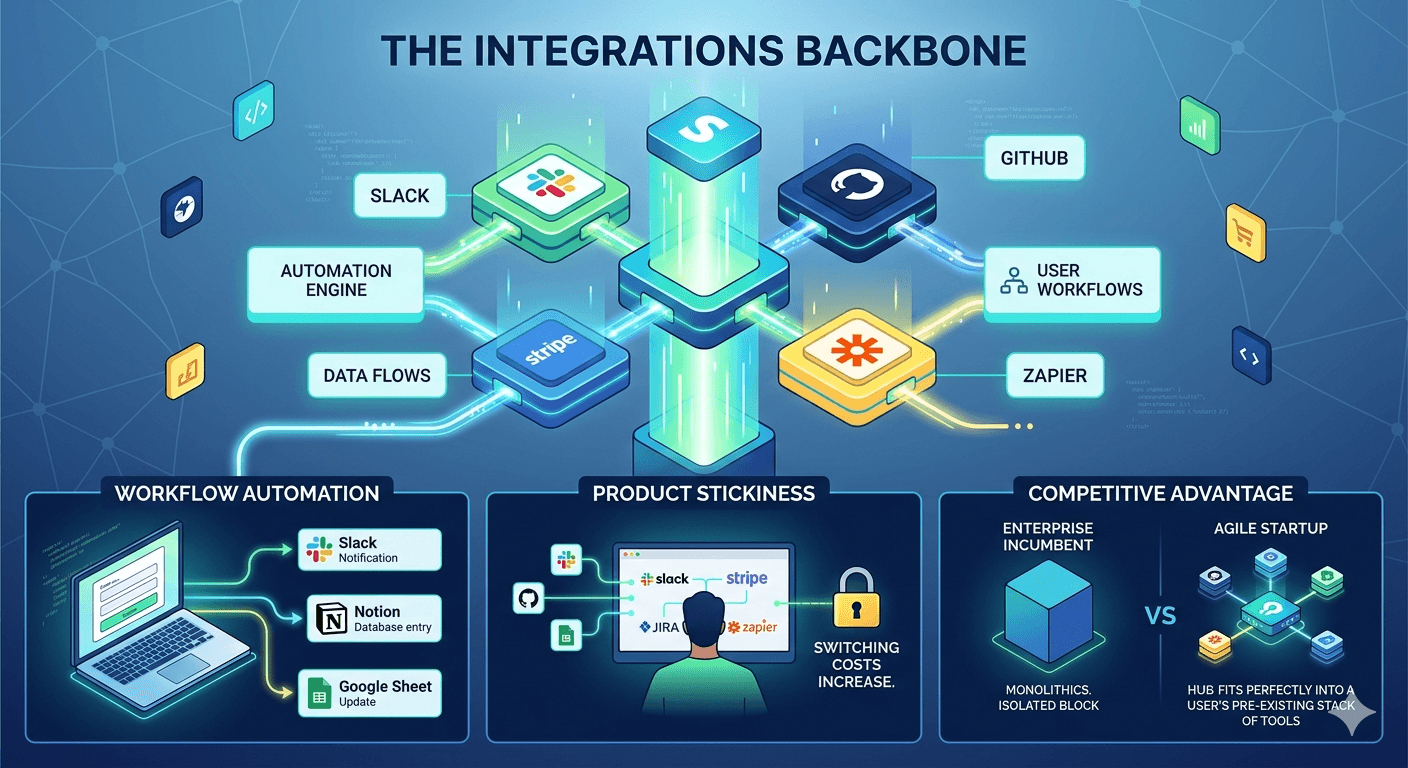
There's a moment every SaaS founder eventually faces — a user writes in and says something like, "This tool is great, but does it connect with Slack?" And if the answer is no, there's a quiet but very real chance that user is already looking for an alternative.
That might sound dramatic. But in today's software landscape, integrations aren't a bonus feature. They're table stakes. Users have built their workflows around a stack of tools they trust — Notion for docs, Jira for tickets, Stripe for billing, Zoom for calls — and they're not going to dismantle that stack for a new product. What they want is a product that fits into their existing world. Seamlessly. Without friction.
The SaaS companies that understand this don't just build features. They build bridges.
The Modern User Has a Stack — And They're Fiercely Loyal To It
Think about how a typical product manager starts their day. They open Slack to catch up on overnight messages. They check their Google Calendar for meetings. They glance at the Jira board to see what's in sprint. Before they've even had a second cup of coffee, they've touched four or five different tools.
Now imagine you're selling them a project management SaaS. If your product doesn't talk to Jira, Slack, or Google Calendar — even a little — you're asking them to manage another silo. Another tab. Another thing to check. And people are already drowning in those.
The reality is that no single SaaS product can — or should — try to do everything. Notion is great at docs and databases, but it's not going to replace your ticketing system. GitHub is phenomenal for code, but your sales team isn't living there. Each tool in someone's stack has earned its place. What users want from a new SaaS product is simple: play nice with the tools I already use.
Integrations as Workflow Automation: Doing the Boring Work So Your Users Don't Have To
One of the most underrated benefits of third-party integrations is what they unlock in terms of automation. Not the flashy AI-generated-summary kind of automation — the quiet, reliable, saves-me-20-minutes-a-day kind.
Consider a startup using a customer support platform. When they connect it to Slack, support ticket notifications flow directly into the right channel. When it's connected to a CRM like HubSpot or Salesforce, every ticket gets automatically associated with the customer's profile — no manual data entry, no copy-pasting across tabs. When escalations trigger a Zoom call, the link gets shared automatically.
Individually, those are small conveniences. Collectively, they represent hours recovered every week. For a lean startup team where every hour counts, that's not a nice-to-have. That's a serious competitive advantage.
Zapier takes this idea to its logical conclusion — by acting as the connective tissue between apps that don't natively integrate, it lets users build custom workflows without touching a line of code. A new form submission triggers a Slack message and creates a Notion database entry and adds a row to a Google Sheet. That chain of automation used to require a developer. Now it takes twenty minutes and a Zapier account.
Stickiness: The Quiet Business Case for Deep Integrations
Let's talk about something SaaS founders think about constantly but don't always say out loud: churn.
Integrations are one of the most powerful anti-churn mechanisms a product can have — and the reason is almost psychological. When a user has connected your product to six other tools in their stack, switching costs go way up. It's not just about canceling a subscription anymore. It's about re-plumbing their entire workflow. Most people won't do that unless they have a really good reason.
This is what product people call "stickiness," and integrations create it in a way that features alone can't. Features can be copied. Integrations — especially deeply embedded ones — create a kind of organizational muscle memory. Teams start building processes around them. When those processes work, the product becomes infrastructure. And you don't rip out infrastructure lightly.
Slack understood this better than almost anyone. It built one of the most generous integration ecosystems in SaaS history, and by doing so, it made itself indispensable to tens of thousands of teams. By the time Microsoft Teams showed up with a huge enterprise push, many companies didn't switch — not because Slack was dramatically better, but because it was already woven into how their teams worked.
Real-World Use Cases: Where Integrations Actually Live
Sales & CRM Pipelines
A sales team living in Salesforce or HubSpot needs their prospecting tool, email platform, and meeting scheduler to all talk to each other. When a rep books a meeting through Calendly and it automatically creates a deal in HubSpot, logs the activity, and sends a Slack notification to the manager — that's a workflow that actually gets used. Compare that to a tool that requires manual data entry at each step, and the choice is obvious.
Developer Workflows
For engineering teams, GitHub is practically a religion. Any developer tool that doesn't integrate with GitHub — for pull request tracking, deployment triggers, incident alerts, or sprint planning — is going to face serious skepticism. The same goes for Jira. When a code deployment in GitHub triggers a Jira ticket status update and pings a Slack channel, the entire team stays in sync without anyone having to write a single status update manually.
Team Collaboration & Scheduling
Remote-first teams depend on Zoom and Microsoft Teams for almost everything. A scheduling tool that doesn't generate a Zoom link automatically when a meeting is booked is annoying in a way that's hard to articulate but very easy to feel. Google Calendar and Outlook integrations are similarly non-negotiable. Nobody wants to manually copy meeting details from one system to another in 2025.
Billing & Payments
Stripe has become the default for SaaS billing — so deeply integrated into the ecosystem that many platforms don't even try to build payment infrastructure themselves. They just connect to Stripe. When a subscription SaaS connects its billing, CRM, and customer success tools together, support teams can see payment status directly in the ticket. Sales can see who's on which plan. Finance can pull reports without chasing anyone.
Why Integrations Help You Win Against Bigger Competitors
One thing that doesn't get talked about enough: integrations are a way for smaller SaaS companies to punch above their weight.
Here's the scenario. A startup enters a market dominated by an enterprise player with decades of history and a massive sales team. The startup can't win on brand. It probably can't win on features alone. But if it integrates beautifully with every tool that the enterprise player's product ignores — if it connects to Notion when the old guard doesn't, or builds a clean GitHub app when the incumbent barely has one — it can win on fit.
Niche SaaS tools that integrate deeply with the broader ecosystem feel more powerful than they actually are, because they extend the tools people already love. A small team communication app that plugs into Jira, Notion, and Slack feels like it belongs with the big players. And increasingly, that perception is what drives purchasing decisions, especially in product-led growth motions where the end user, not the IT department, is choosing the software.
The Integration Ecosystem as a Growth Channel
There's another angle here that's worth addressing: integrations as distribution.
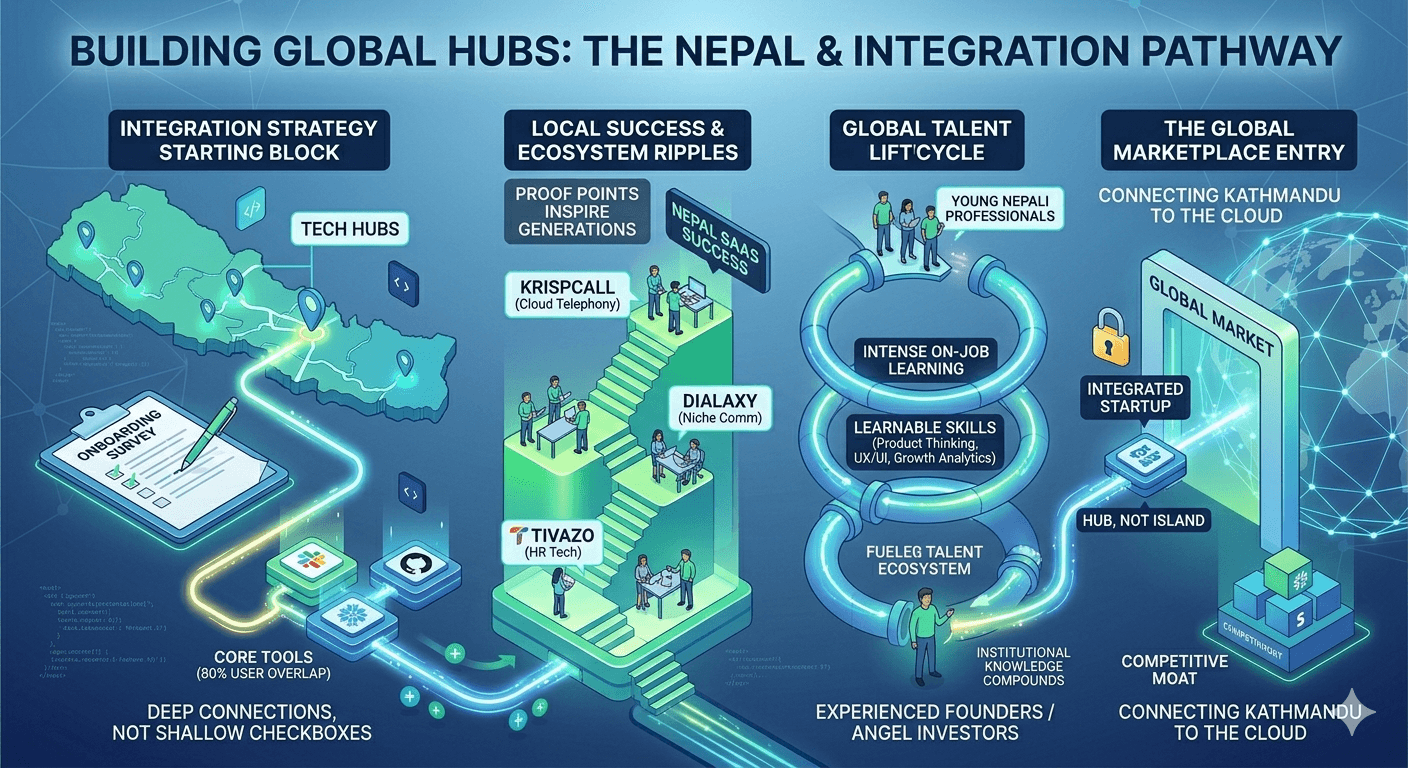
“Companies like KrispCall, Dialaxy, and Tivazo are doing more than building products — they're demonstrating what's possible.”
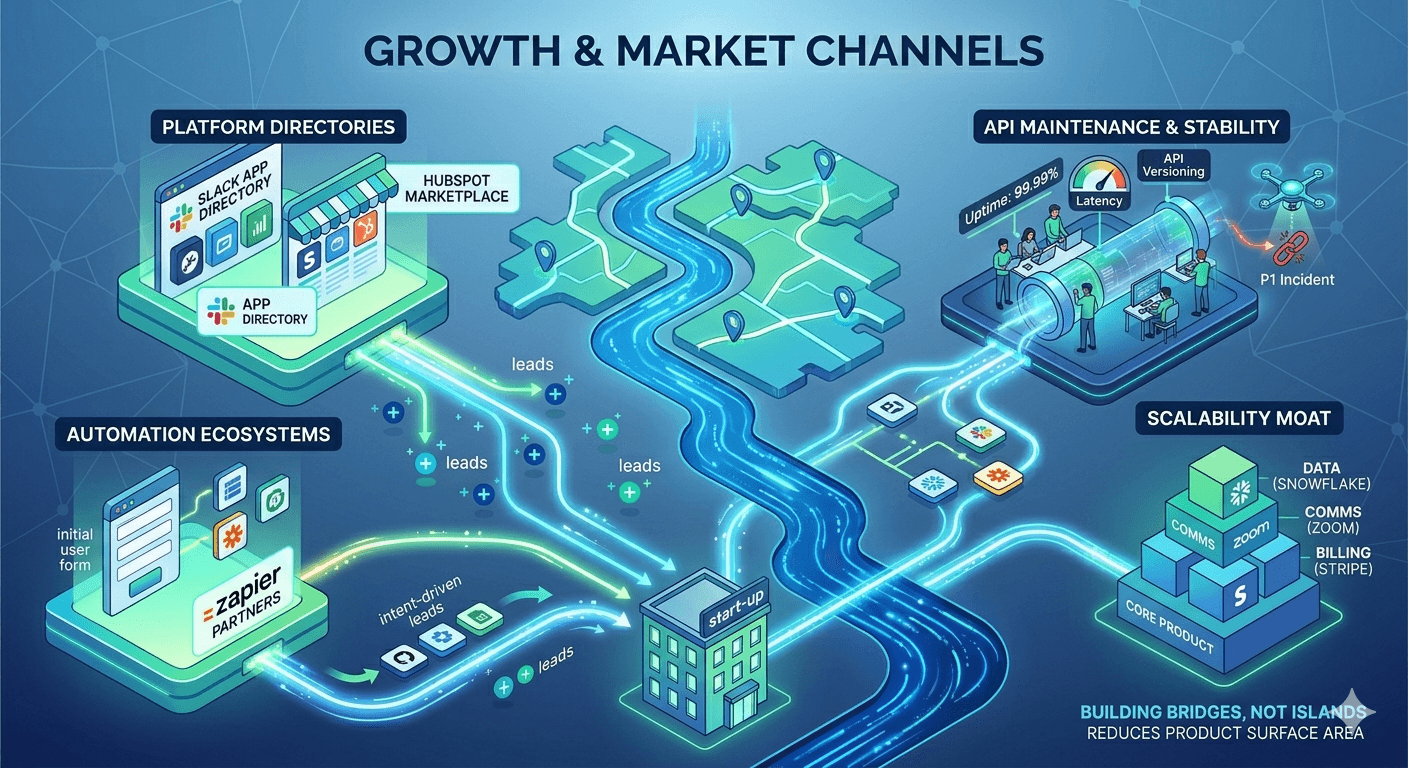
When you list your product on the Slack App Directory, the HubSpot App Marketplace, or Notion's integration gallery, you're putting your product in front of users who are actively looking for tools that fit their existing stack. These aren't cold leads. They're warm, intent-driven users who already know what ecosystem they're building in.
Zapier's partner program has driven significant growth for hundreds of SaaS companies — not because Zapier is a marketing platform, but because being featured as a Zapier integration signals to thousands of automation-focused users that your product is ready to play nicely with others.
For a startup with a limited marketing budget, getting listed in the right ecosystem can drive more qualified signups than a paid campaign. And the cost of building that integration, while real, is often a one-time investment that pays off for years.
What It Actually Takes to Get Integrations Right
It's worth being honest here: building integrations isn't trivial. API maintenance is ongoing. Versioning breaks things. Authentication flows cause user confusion. And when a third-party changes something on their end, your integration breaks — and your users blame you, not them.
But the teams that get this right treat integrations as a product discipline, not an afterthought. They document them properly, monitor them with alerting, and treat an integration breaking as a P1 incident. The best SaaS companies have dedicated integration engineers or platform teams whose entire job is to make sure the connective tissue stays healthy.
The companies that treat integrations as a checkbox — ship it, forget it — end up with a graveyard of half-working connections that generate more support tickets than they prevent. The ones that treat integrations as a core product feature end up with the kind of deep workflow embedding that makes churn nearly impossible.
The Business Case: Scalability, Satisfaction, and Competitive Moat
For SaaS founders thinking about the bigger picture, the business case for prioritizing integrations is hard to argue with.
On the scalability side, integrations reduce the surface area your product has to cover. Instead of building a native video conferencing feature, integrate with Zoom. Instead of building a native billing module, connect to Stripe. You move faster, your product stays focused, and your users get a better experience because they're using the best-in-class tool for each job.
On the satisfaction side, research consistently shows that users who have deeply integrated a product into their workflow report higher satisfaction scores. They feel like the product understands how they work. They don't have to context-switch unnecessarily. The experience feels coherent even though it involves multiple vendors.
And on the competitive moat side, an integration ecosystem is genuinely hard to replicate. It takes years to build the partnerships, maintain the connections, earn the listings in partner directories, and accumulate the user trust that comes from those integrations working reliably. A well-built integration ecosystem is one of the more durable advantages a SaaS company can have.
For Founders and Product Teams: Where to Start
If you're a founder reading this and you're early in thinking about your integration strategy, here's a practical lens: start with where your users already spend their time.
“This is probably the best moment in Nepal's history to be building a career in tech.”
Do a survey. Look at support conversations. Ask in onboarding calls. You'll likely find that 80% of your users have 3 to 5 tools in common. Those are your first integrations. Build them well, document them clearly, and promote them. Then listen to what comes next.
Don't try to integrate with everything at once. A deeply working Slack integration is worth ten shallow ones. Users will notice the quality. They'll tell their colleagues. They'll mention it in reviews. Good integrations have a word-of-mouth quality that's hard to manufacture any other way.
And don't underestimate the ongoing investment. Assign ownership. Monitor reliability. Treat each integration like a small product in its own right — because for your users who depend on it, that's exactly what it is.
Here's the thing about modern software: the best products are rarely islands. They're hubs. They're nodes in a larger ecosystem that users have carefully assembled over time.
The SaaS companies winning today — the ones with the low churn, the strong NPS, the word-of-mouth growth — are almost always the ones that made it easy to connect. Easy to plug in. Easy to fit into whatever stack a user walked in with.
If you're building a SaaS product and integrations feel like a later-stage concern, it might be worth reconsidering. Because for your users, the question isn't just "does this product do what I need?" It's also, quietly but crucially, "does this product fit where I live?"
The answer to that second question is almost always written in integrations. And the companies that get that answer right — early, deliberately, and consistently — are the ones that end up looking inevitable in hindsight.