

Not long ago, the typical dream for a young Nepali graduate was straightforward: land a government job, join a bank, or find a way to work abroad. Stability was the goal. Risk was something to avoid. And "entrepreneurship" — well, that was a word most families associated with running a hardware shop or a restaurant, not building software that could serve customers in New York, London, or Sydney.
That story is changing. Fast.
Walk into any co-working space in Kathmandu today, sit down at a café in Lalitpur, or scroll through LinkedIn profiles of Nepali professionals in their mid-twenties, and you'll notice something different. People are talking about product-market fit. They're debating SaaS pricing models. They're shipping features for international clients. They're building things.
Nepal's software-as-a-service ecosystem isn't just growing — it's quietly becoming one of the more interesting startup stories in South Asia. Companies like Tivazo, KrispCall, and Dialaxy aren't household names globally yet. But they're doing something that matters: proving that a product built in Nepal can compete, scale, and win customers anywhere in the world. And in doing so, they're creating something equally important — a blueprint for an entire generation of young Nepali professionals who are beginning to believe that they don't have to leave the country to build something meaningful.
SaaS Is Not Just a Buzzword Anymore
Let's start with the basics, because it still matters to get this right. SaaS — software as a service — means you build a product once, host it in the cloud, and sell access to it on a subscription basis. There's no shipping, no inventory, no warehouse. Your customers could be in Kathmandu or Cape Town. Your team could work from Baneshwor or Banepa. The model is global by design.
For a country like Nepal, that's a genuinely revolutionary concept. Historically, Nepal's IT sector has been dominated by outsourcing — building someone else's software for a fixed rate, delivering projects, and moving on. That model has its place, and it's fed a lot of families. But it has a ceiling. You trade time for money, and the margins are often thin.
SaaS flips this. When a Nepali company builds its own product and acquires even a few hundred paying customers abroad, the economics change dramatically. Every new customer adds revenue without proportionally adding cost. The product works while the team sleeps. That's the compounding power that makes SaaS so attractive — and why smart founders and investors are paying close attention to what's happening in Nepal's tech scene right now.
KrispCall: A Nepal-Born Product Competing Globally
If you want a concrete example of what's possible, KrispCall is one of the most compelling. Founded in Nepal, KrispCall is a cloud telephony platform — essentially a business phone system that runs over the internet. It lets companies manage calls, messages, and communication without physical phone lines or hardware. It's the kind of product that a company in the US or Europe would use to set up a virtual office phone number, manage customer support, or run a distributed sales team.
What makes KrispCall interesting isn't just the product — it's the trajectory. The company has acquired customers across North America, Europe, and Australia. It competes with players from much larger markets and, by most accounts, holds its own. The team behind it is largely Nepali. The engineering, the product design, the growth marketing — a lot of that work is happening right here.
For young professionals in Nepal, KrispCall represents something concrete: proof that a product built locally can find a paying audience globally. That's not a small thing. It challenges the assumption that you need to be based in Silicon Valley or Bangalore to build a meaningful SaaS business.
Dialaxy and the Power of Niche Focus
Dialaxy is another name worth understanding. It operates in the cloud communication space — similar territory to KrispCall, though with its own positioning and feature set. What's notable about Dialaxy is how it demonstrates the power of going deep into a specific problem rather than trying to do everything at once.
Cloud communication tools might sound like a saturated market to an outsider. Twilio, RingCentral, and dozens of others have been in the space for years. But Dialaxy found its angle — targeting specific customer segments, pricing competitively, and building a product that solves real workflow problems for small and medium-sized businesses.
This kind of niche-first thinking is increasingly common among Nepal's more successful SaaS companies. Rather than trying to out-resource giants with unlimited budgets, they're finding underserved corners of the market, moving quickly, and building genuine product expertise. It's a smart playbook, and it's one that Nepal's founders are executing with increasing sophistication.

Tivazo: The HR and Productivity Angle
Then there's Tivazo, which takes a different approach entirely. Focused on workforce management and productivity tools, Tivazo is building software that helps companies manage remote teams, track work, and handle HR-related workflows. It's a space that exploded in relevance after the pandemic permanently shifted how many businesses think about distributed work.
Tivazo's positioning is interesting because it addresses a problem that's both global and personal to the Nepali context. Nepal has a large population of professionals working remotely — either for foreign companies or within distributed domestic teams. The founders understand this problem from the inside, which gives them a genuine perspective that shows up in the product.
What Tivazo also represents is the diversification of Nepal's SaaS landscape. Not every product has to be in fintech or communication. HR tech, productivity tools, vertical-specific software, e-commerce infrastructure — there are dozens of product categories where Nepali founders can build meaningful businesses if they approach the problems with the right depth and patience.
The Jobs Being Created — And Why They Matter
Here's where things get particularly exciting if you're a young Nepali professional trying to figure out your next move.
When a SaaS company like KrispCall or Dialaxy grows, it doesn't just create engineering jobs. It creates entire ecosystems of roles that didn't exist in Nepal's job market a decade ago. Think about what a typical SaaS company needs:
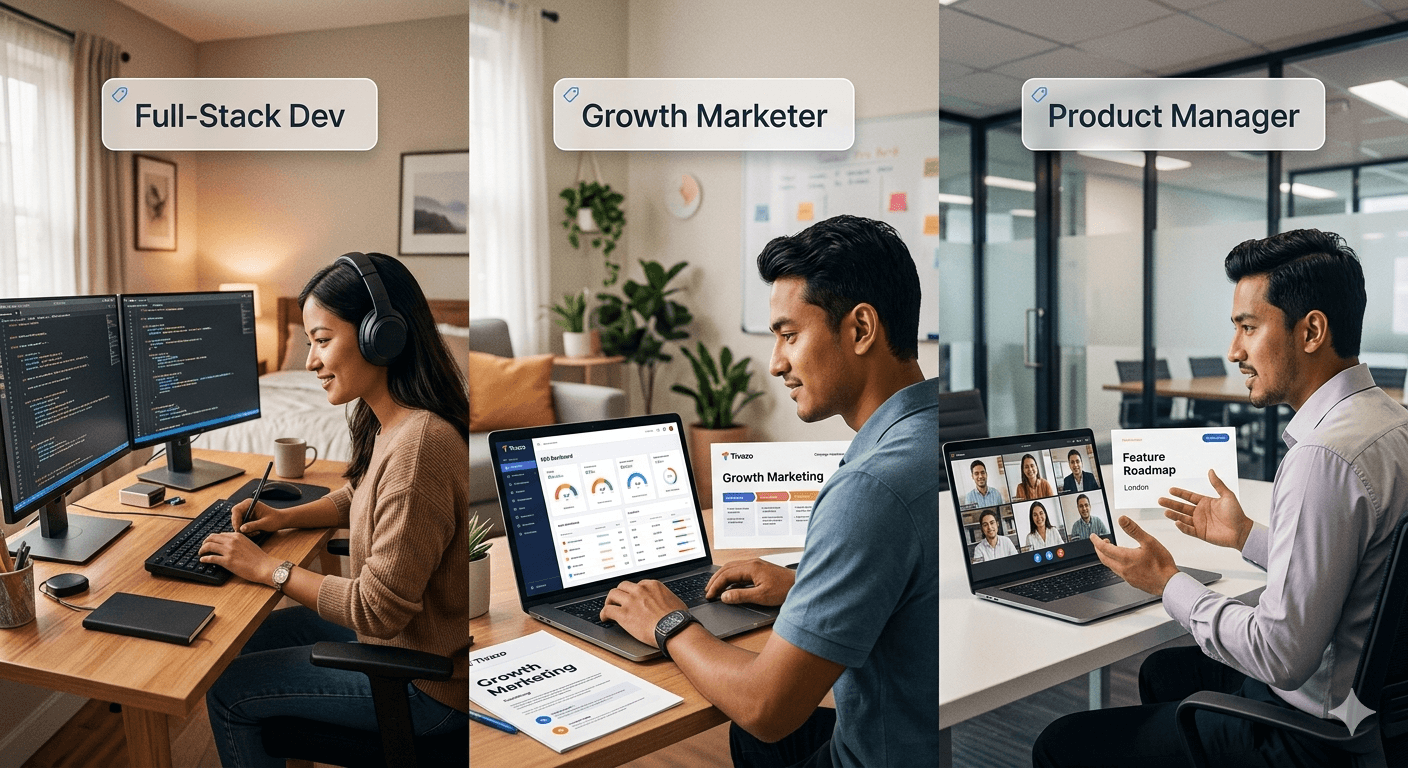
Product managers who can translate customer problems into features. UX/UI designers who understand how users in different markets think and interact with software. Growth marketers who can run paid campaigns, write content, manage SEO, and build referral programs. Customer success managers who build relationships with clients, reduce churn, and identify upsell opportunities. Sales development reps who reach out to prospects across time zones. Data analysts who dig into user behavior and help the team make smarter decisions. DevOps engineers, QA specialists, technical writers, finance people who understand SaaS metrics.
These are all real jobs with real career trajectories. And increasingly, they're being filled by Nepali professionals who are learning these skills through a combination of online education, peer learning, and on-the-job experience inside companies like these.
The ripple effects are meaningful. A junior developer who joins a SaaS startup doesn't just learn to code — they learn how products are built, how customers are acquired, how metrics drive decisions. That knowledge compounds over time into a generation of professionals who understand the global tech economy from the inside.
The Mindset Shift Is the Real Revolution
Ask any founder who's been building in Nepal for a few years, and they'll tell you that the biggest challenge isn't always technology or funding — it's mindset. Both their own, and the culture around them.
“Companies like KrispCall, Dialaxy, and Tivazo are doing more than building products — they're demonstrating what's possible.”
There's still a pull toward the traditional. Parents want stable government jobs. Banks are seen as prestige. Going abroad — to the Gulf, to South Korea, to Australia — is still the dominant economic strategy for hundreds of thousands of Nepali families. That context is real, and it's not going away overnight.
But something is shifting, especially in urban areas and among the generation that grew up with smartphones and YouTube and unrestricted access to the internet. These young people see what's happening in India, in Southeast Asia, in Africa. They see 22-year-olds building products that reach millions of people. They see remote work as a legitimate career path. They see entrepreneurship not as recklessness, but as a calculated bet.
Companies like KrispCall, Dialaxy, and Tivazo are doing more than building products — they're demonstrating what's possible. Every time one of them raises a funding round, lands a significant customer, or gets covered in an international tech publication, it adds a data point to a counter-narrative that says: you can build something from here.
That counter-narrative is accumulating momentum. You can feel it in the energy of communities like Founders Club Nepal, in the growing number of people attending startup events, in the college students who are already thinking about problems they want to solve rather than companies they want to join.
The Challenges Are Real — Let's Not Pretend Otherwise
A balanced account has to acknowledge the headwinds too. Building a SaaS company in Nepal is genuinely hard in ways that go beyond the difficulty of building the product itself.
Access to capital is still limited. Most Nepali startups are bootstrapped or rely on small seed checks from angel investors. The venture capital ecosystem is still nascent compared to India or Southeast Asia. That means founders often have to grow slower, be scrappier, and prove more before they can raise meaningful money.
Hiring is another challenge. The talent pool is growing, but so is competition for it. Companies in India, the US, and Europe are increasingly hiring remote Nepali developers at attractive salaries — which is great for those individuals but creates pressure for local startups that can't always match those compensation packages.
Payment infrastructure and regulatory complexity add friction for companies trying to collect revenue from international customers. The process of receiving foreign currency, complying with Nepal Rastra Bank regulations, and managing cross-border transactions is more complicated than it should be, though things are slowly improving.
And there's the market access challenge. Building relationships with potential customers in North America or Europe from Kathmandu requires creativity, hustle, and patience. Time zones, trust gaps, and limited brand recognition all make the initial sales motion harder than it would be if you were based in those markets.
None of these are insurmountable. But they're real, and any honest account of Nepal's SaaS ecosystem has to include them alongside the optimism.
What the Next Five Years Could Look Like
Despite the challenges, the trajectory is pointing in a promising direction.
More Nepali developers are gaining experience inside SaaS companies — both locally founded ones and international companies that hire remotely. That experience is creating a generation of people who know how to build, grow, and operate software products. Some of them will start their own companies. Others will join early-stage startups. Either way, the talent base is deepening.
The government, slowly and imperfectly, is beginning to recognize the digital economy as a priority. Policies around digital payments, startup registration, and tech infrastructure are gradually improving. It's not fast enough for most people in the ecosystem, but the direction is right.
And the global market is more accessible than ever. Cloud infrastructure from AWS and Google has made it possible to build and scale a product with relatively modest upfront investment. Tools for marketing, customer support, analytics, and team collaboration are available to a Nepali startup just as easily as to one in San Francisco. The playing field, while not perfectly level, is more level than it's ever been.
If the next five years see even a handful of Nepali SaaS companies reach meaningful scale — say, a few thousand customers and teams of 50 to 100 people — the knock-on effects will be significant. More experienced founders. More angel investors who've made money from startups. More proof points for young people who are on the fence about taking the entrepreneurial leap.
For Young Professionals: This Is the Moment
If you're a young Nepali professional reading this — whether you're a developer, a designer, a marketer, or someone still figuring out where you fit — here's an honest observation: this is probably the best moment in Nepal's history to be building a career in tech.
“This is probably the best moment in Nepal's history to be building a career in tech.”
The companies being built right now are creating the institutional knowledge, the career paths, and the cultural permission for thousands of people to follow. The skills that SaaS companies need — product thinking, growth hacking, user research, technical skills, customer empathy — are learnable. They're not secrets held in Silicon Valley boardrooms. They're documented extensively online and increasingly practiced by people right here in Nepal.
Getting involved doesn't necessarily mean founding a startup. It might mean joining one early, before it's well-known, and learning everything you can about how a product is built and grown. It might mean building a specific skill — content marketing, growth analytics, mobile development — that makes you valuable to this emerging ecosystem. It might mean going deep on a problem domain and building expertise that positions you to eventually start something.
Whatever path makes sense for you, the window is open right now in a way it wasn't five or ten years ago. The infrastructure is better. The examples exist. The network is forming. The global market is reachable.
Companies like Tivazo, KrispCall, and Dialaxy aren't just businesses. They're evidence. Evidence that Nepali founders can build products the world uses. Evidence that the talent exists. Evidence that with the right combination of product insight, persistence, and timing, something meaningful can be built from here.
That evidence is still being written. And the next chapter might very well have your name in it.
Nepal's SaaS story is still in its early chapters. The companies making noise today — KrispCall disrupting cloud telephony, Dialaxy carving its niche in business communication, Tivazo rethinking workforce management — are pioneers in the truest sense. They're building without a well-worn path, creating the map as they go.
But the trajectory is visible and the momentum is real. A generation of Nepali professionals is beginning to see that building global products isn't a fantasy reserved for people in richer countries with better infrastructure. It's something that can happen from a Kathmandu apartment, a Pokhara café, or a co-working space in Patan — if you're willing to learn, ship, and persist.
The rise of SaaS in Nepal isn't just a technology story. It's a story about what happens when a culture starts to believe that it can create, not just consume; build, not just service; lead, not just follow. That belief, once it takes root in enough people, has a tendency to become self-fulfilling.
And from where things stand today, that belief is taking root.