
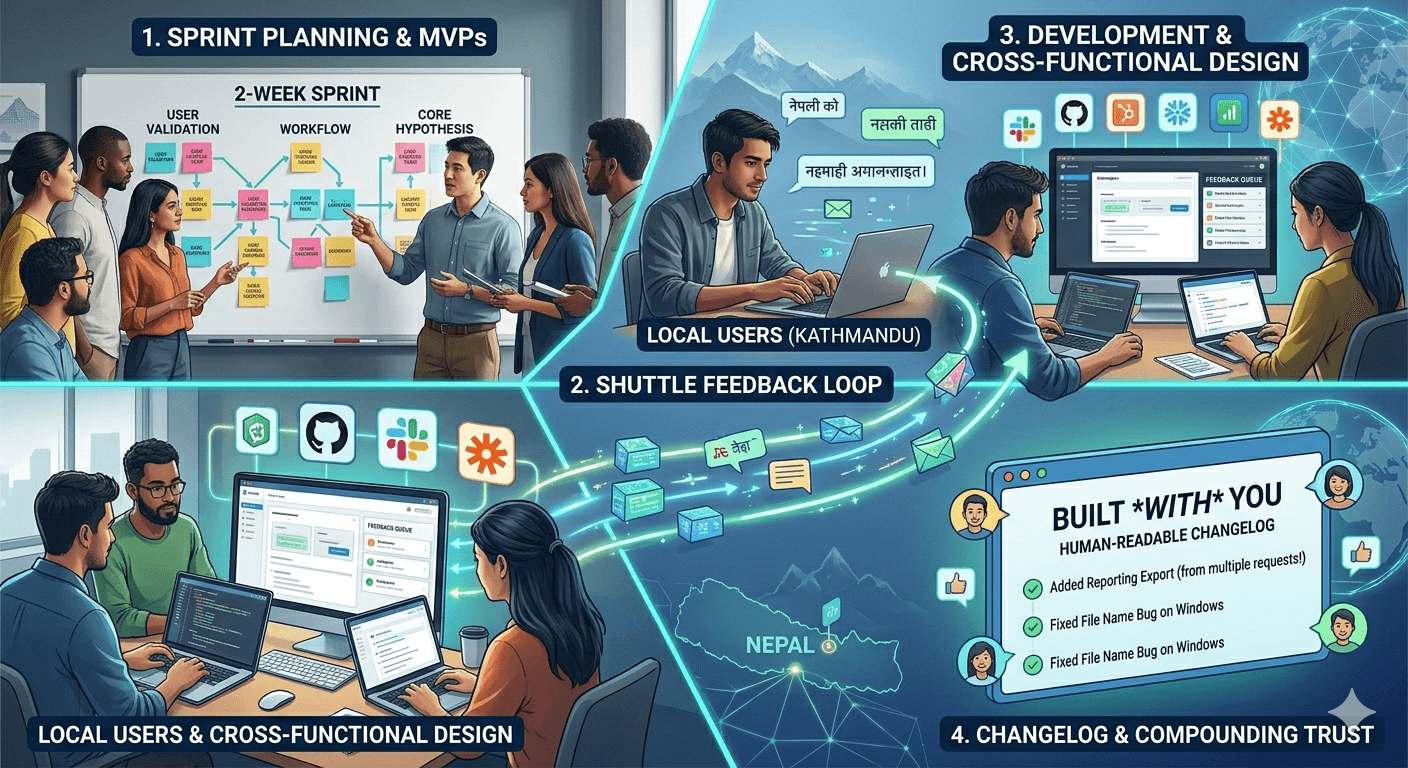
Nobody builds the perfect SaaS product in a vacuum. Not even close.
The version you ship on launch day and the version your users actually need are almost never the same thing. And that's not a failure of planning — it's just the nature of building software that real people use in the real world, with real workflows, real edge cases, and real expectations you couldn't fully anticipate from a whiteboard.
The SaaS teams that grow the fastest are rarely the ones with the most polished roadmap. They're the ones who ship early, listen hard, and iterate without ego. They treat the product as a living thing — something that gets better not because of one brilliant vision, but because of a thousand small signals collected from actual users doing actual work inside it every day.
This is what building SaaS in real time looks like. And it's messier, more human, and ultimately more effective than most people realize before they've done it.
It Starts Before the First Line of Code
The worst time to discover that nobody wants what you're building is after you've spent six months building it. That sounds obvious when you say it out loud. And yet, it happens constantly.
The teams that avoid this trap don't do it through superior intelligence — they do it through disciplined validation before development begins in earnest. Conversations with potential users. Surveys. Prototype testing. Landing pages that describe a product that doesn't exist yet, just to see if people click "Sign Up." Sometimes that research confirms your hypothesis. Often it shifts it in ways you didn't expect.
One founder building a client reporting tool for marketing agencies spent three weeks interviewing agency owners before writing a single line of code. What she thought would be a simple dashboard turned into a product centered around automated narrative summaries — a feature she wouldn't have prioritized at all based on her original assumptions. That pivot, made before any development investment was at stake, saved months and shaped the product into something that actually fit.
Validation isn't glamorous work. But it's the foundation everything else is built on.
The MVP Is a Hypothesis, Not a Promise
There's a lot of confusion about what a minimum viable product actually is. Some teams build an MVP that's barely functional — three screens and a prayer — and call it a launch. Others spend a year "building the MVP" until it's essentially a full product. Neither extreme is useful.
The right MVP is the smallest version of your product that can actually test your core assumption. Not the most minimal thing you can technically ship. The most minimal thing that lets real users experience the core value you're offering and give you meaningful signal about whether it works for them.
For a SaaS tool built around automated invoice reconciliation, the MVP might be a manual process backed by a lightweight interface — because the job to be done is reducing reconciliation errors, and you can test whether users trust the output before you invest in full automation. The automation comes later, after you know the approach works.
This mindset matters because it changes how you think about the launch. You're not shipping a finished product. You're running an experiment. And experiments are allowed — expected, even — to generate uncomfortable data.
Early Users Are Co-Builders, Not Just Customers
The first hundred users of a SaaS product are in a different category than customers. They're more like collaborators. They're using something raw, tolerating friction that later users won't have to deal with, and in many cases, they're willing to tell you exactly what's wrong if you make it easy for them to do so.
The teams that get the most out of early users treat this relationship explicitly. They're upfront about the product being early-stage. They schedule check-in calls. They send surveys after the first week. They watch session recordings obsessively. They respond personally to every support ticket, not because they have to, but because each one is intelligence.
One pattern that works particularly well: after onboarding, send a short email asking three specific questions. Not "how do you like the product?" — that's too broad and produces generic answers. Something more like: "Was there a moment in the last week where you wanted to do something and couldn't figure out how? What were you trying to do?" That kind of specificity unlocks honest, actionable responses.
Early users who feel genuinely heard tend to become advocates. They refer friends. They leave reviews. They stick around even when the product has rough edges, because they feel invested in what it's becoming.
Feedback Is Everywhere — Most Teams Aren't Looking in the Right Places
Support tickets are the most obvious feedback channel, and most teams at least monitor them. But the richest product intelligence often lives elsewhere.
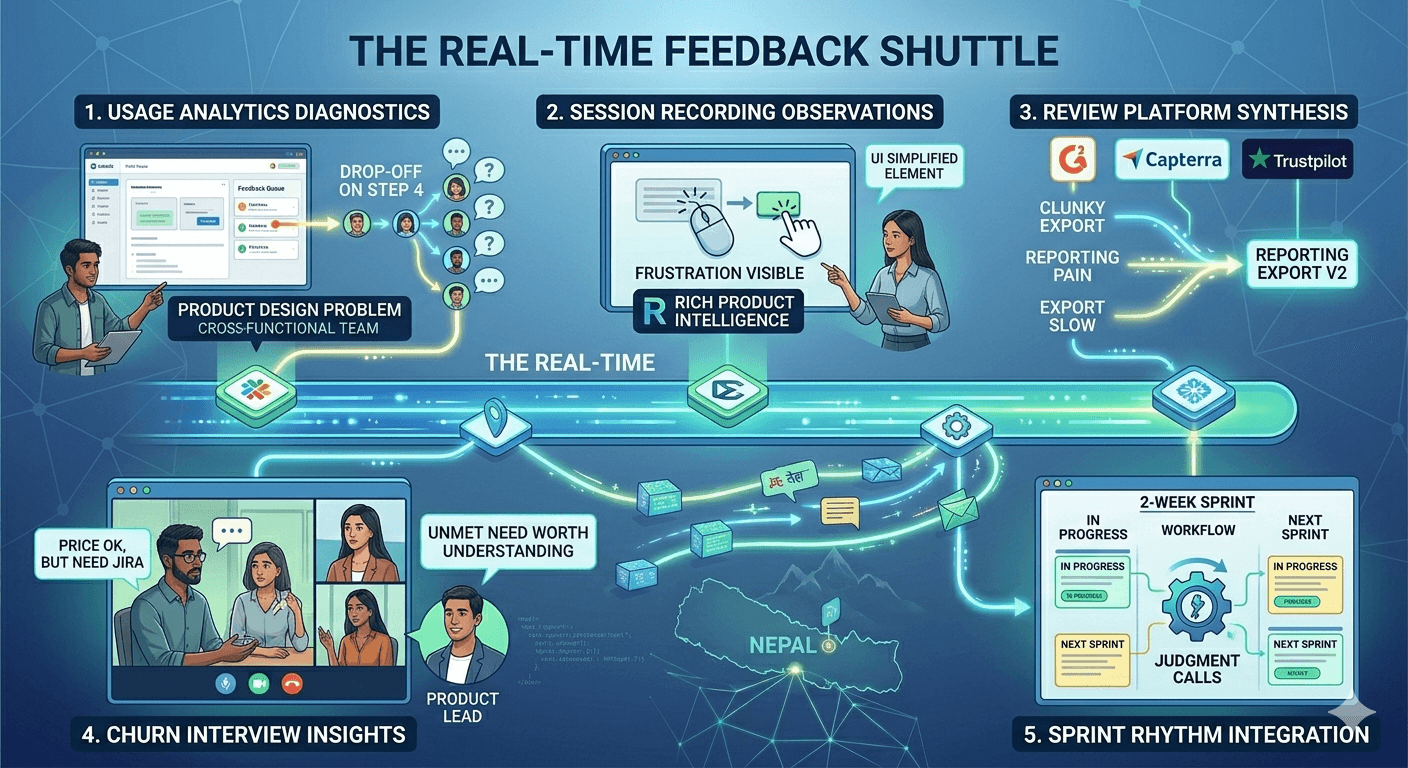
Usage analytics tell you what users do, not what they say they do. When you see that 60% of users who start your onboarding flow drop off on step four, that's not a user education problem — that's a product design problem. The step is confusing, or unnecessary, or it's asking for information the user doesn't have yet. No amount of better documentation fixes that. You have to change the step.
Session recordings — tools like Hotjar or FullStory capture anonymized video of how users interact with your UI — show you things you'd never discover through surveys. You'll watch a user click the same non-clickable element three times. You'll see someone spend four minutes looking for a button that's right in front of them. That's frustration made visible. It's some of the most direct feedback you can get.
Review platforms matter too. G2, Capterra, Trustpilot — whatever's relevant for your market. Users write things in public reviews they might not say in a direct survey, partly because they're writing for an audience. The tone is more honest. The complaints are more specific. If three different reviewers all mention that your reporting export is "clunky," that's a product priority hiding in plain sight.
Churn interviews are the most underused feedback channel in early-stage SaaS. When a customer cancels, most teams send an automated email asking why. A few teams actually call the customer. Those calls are uncomfortable and valuable in equal measure. The discomfort is almost always worth it.
The Sprint Rhythm: How Real Product Teams Stay Sane and Shipping
Agile development gets discussed in abstract terms a lot. In practice, for a small SaaS team, it usually boils down to a fairly simple rhythm: two-week sprints, a backlog that gets groomed weekly, a standup that actually stays under fifteen minutes, and a retrospective that generates at least one concrete change to how the team works.
The sprint planning meeting is where feedback gets translated into work. At the start of each sprint, the team — typically engineers, a designer, a product lead, and whoever represents customer-facing insights — sits down with the prioritized backlog and makes deliberate decisions about what gets built next. The criteria aren't just "what's most important" in the abstract. They're more nuanced: what's causing the most user pain, what's blocking adoption, what's been requested by multiple customers, what has the best ratio of impact to effort.
Feature requests from customers don't automatically go into the sprint. They go into the backlog. Then the team evaluates them against the product strategy, the technical constraints, and the user data. A feature that five customers have explicitly requested might still rank below a performance improvement that affects everyone. The judgment calls are constant, and they require a team that's comfortable making them under uncertainty.
One thing that helps: a shared definition of what "done" means. Not just coded. Not just in staging. Tested, documented, and deployed to production — that's done. Keeping that standard consistent prevents the slow accumulation of half-finished work that eventually grinds teams to a halt.
Bugs Are Inevitable. How You Handle Them Is Not.
Every SaaS product has bugs. The teams that pretend otherwise are either lying to themselves or haven't had enough real users yet. The question isn't whether bugs will happen — it's how fast you find them, how clearly you communicate about them, and how permanently you fix them.
“Companies like KrispCall, Dialaxy, and Tivazo are doing more than building products — they're demonstrating what's possible.”
A small team building a project management SaaS for creative agencies once shipped a feature that accidentally corrupted file names during uploads for users on Windows machines. The bug only affected a small percentage of their users, but it was a critical workflow issue for the people it hit. The team found it through a support ticket on a Friday evening.
What happened next mattered more than the bug itself. The engineering lead acknowledged it publicly in the product's status page within two hours. A temporary workaround was documented and shared with affected users by email within four hours. The root fix was deployed the following Monday. Every user who had reported the issue got a personal follow-up.
None of that erased the bug. But it built trust in a way that smooth functionality alone can't. Users understand that software breaks. What they're evaluating is whether the team behind it responds like people who care.
When Customer Feedback Shapes the Roadmap
There's a version of product development where the roadmap is set once a quarter by the leadership team and executed without interruption. That model works for large, mature products with stable user bases and well-understood problems. It doesn't work for early-stage SaaS.
In the early stages, the roadmap needs to be a living document. Not infinitely flexible — you can't chase every feature request or you'll build a Frankenstein product with no coherent value proposition — but genuinely responsive to what real users are experiencing.
The best teams have a framework for this. Customer feedback gets tagged and categorized as it comes in — through support, through reviews, through in-app feedback widgets. At the end of each month, someone synthesizes the top themes. If the same pain point surfaces across five different feedback channels in a month, it's not a coincidence. It's a signal.
One SaaS team building a time-tracking tool for consultants spent their first six months focused on clean UI and fast entry. Feedback was mostly positive. Then they started noticing a pattern in support tickets: users kept asking about integrating with their invoicing software. The feature wasn't on the roadmap. It got added. Within two months of shipping it, it became the most commonly cited reason new users signed up — and the most commonly cited reason existing users stayed.
That's what listening looks like in practice. Not reacting to every request. Finding the threads that run through many requests and pulling them.
Balancing Speed with Quality: The Tension Nobody Talks About Enough
Fast iteration and high quality feel like opposites. In some ways, they are. The pressure to ship quickly — especially when you're burning runway or watching a competitor move fast — creates real temptation to cut corners. Skip the QA pass. Push the feature without testing edge cases. Fix it in the next release.
Sometimes those shortcuts are genuinely the right call. If you're testing whether a feature is worth building at all, you don't need it to be perfect — you need it to be usable enough to generate signal. Shipping something rough to a small cohort of engaged users and watching what happens is a legitimate strategy.
But when shortcuts become habitual, technical debt accumulates in ways that eventually slow everything down. What takes two hours to fix now takes two days in six months, because the codebase has grown around it. What affects twenty users today affects two thousand users in a year.
The teams that navigate this well have a simple rule: move fast on things that are reversible, slow down on things that aren't. A UI change is reversible. A database schema decision is not. A new integration can be tested incrementally. A pricing change affects every customer immediately.
Knowing which is which — and having the discipline to act accordingly — is one of the more underrated skills in SaaS product development.
Trust Is Built in the Changelog
There's a specific kind of trust that SaaS products can build that most companies don't think about explicitly: the trust that comes from customers watching the product get better because of them.
“This is probably the best moment in Nepal's history to be building a career in tech.”
When a user submits a feature request and two months later sees it in the release notes, something changes in the relationship. They're not just a customer anymore — they're a contributor. They feel ownership. They're more forgiving of rough edges in other areas because they've seen evidence that the team listens.
This is why changelogs matter more than most startups treat them. Not the technical ones buried in GitHub. The human ones — written in plain language, shipped via email or in-app notification, that say here's what we shipped this week and here's why. The "why" is the part most teams skip. It's also the part that builds the relationship.
Some of the stickiest SaaS products have cultivated communities of power users who feel deeply invested in where the product is going. That investment doesn't happen by accident. It's built deliberately, through consistent communication, genuine responsiveness, and the repeated experience of seeing the team actually act on what they hear.
Building in public — sharing what's coming, asking for input before features are finalized, admitting when something didn't work — amplifies this effect. Users who feel like insiders become advocates. And advocates, in the early stages of a SaaS business, are worth more than almost any marketing spend.
Building a SaaS product in real time is not a clean, linear process. It's iterative and sometimes contradictory. You ship something you're proud of, and users find a bug you missed. You spend a week on a feature, and the usage data suggests nobody cares. You're fairly confident about the roadmap in January, and by March, three customers have asked for the same thing that wasn't anywhere on the list.
That's not dysfunction. That's the job.
The teams that thrive in this environment are the ones who've made peace with the uncertainty — and built processes that let them learn fast, fix quickly, communicate honestly, and keep moving. They treat every support ticket as a window into how someone actually uses the product. They treat every bug as data about where assumptions fell short. They treat every feature request as a clue about an unmet need worth understanding.
And they treat their customers not as an audience for the product they built, but as collaborators in the ongoing process of building the product that's actually needed.
That shift in perspective — from delivering a product to co-evolving one — is what separates the SaaS companies that plateau from the ones that compound. The product never stops getting built. And when you embrace that, it stops feeling like a burden and starts feeling like the whole point.